
Whole House Water Softeners in Arlington
For over 55 years, Texas Water House has been North Texas’s trusted partner for premium whole house water softener systems. Our custom-designed water softening solutions protect your home’s plumbing, extend appliance life, and deliver silky-soft water to every tap in your home. Whether you’re concerned about hard water, dry skin, or the long-term health of your plumbing system, our whole house water softeners provide comprehensive protection.
Northern Texas
service area
At Texas Water House, we are committed to delivering outstanding water solutions to a wide array of locations across Northern Texas. Our services are designed to meet the unique needs of each community, ensuring access to clean, safe, and high-quality water for both residential and commercial clients. Trust Texas Water House to be your partner in ensuring the highest standards of water quality and service excellence in the greater DFW area.
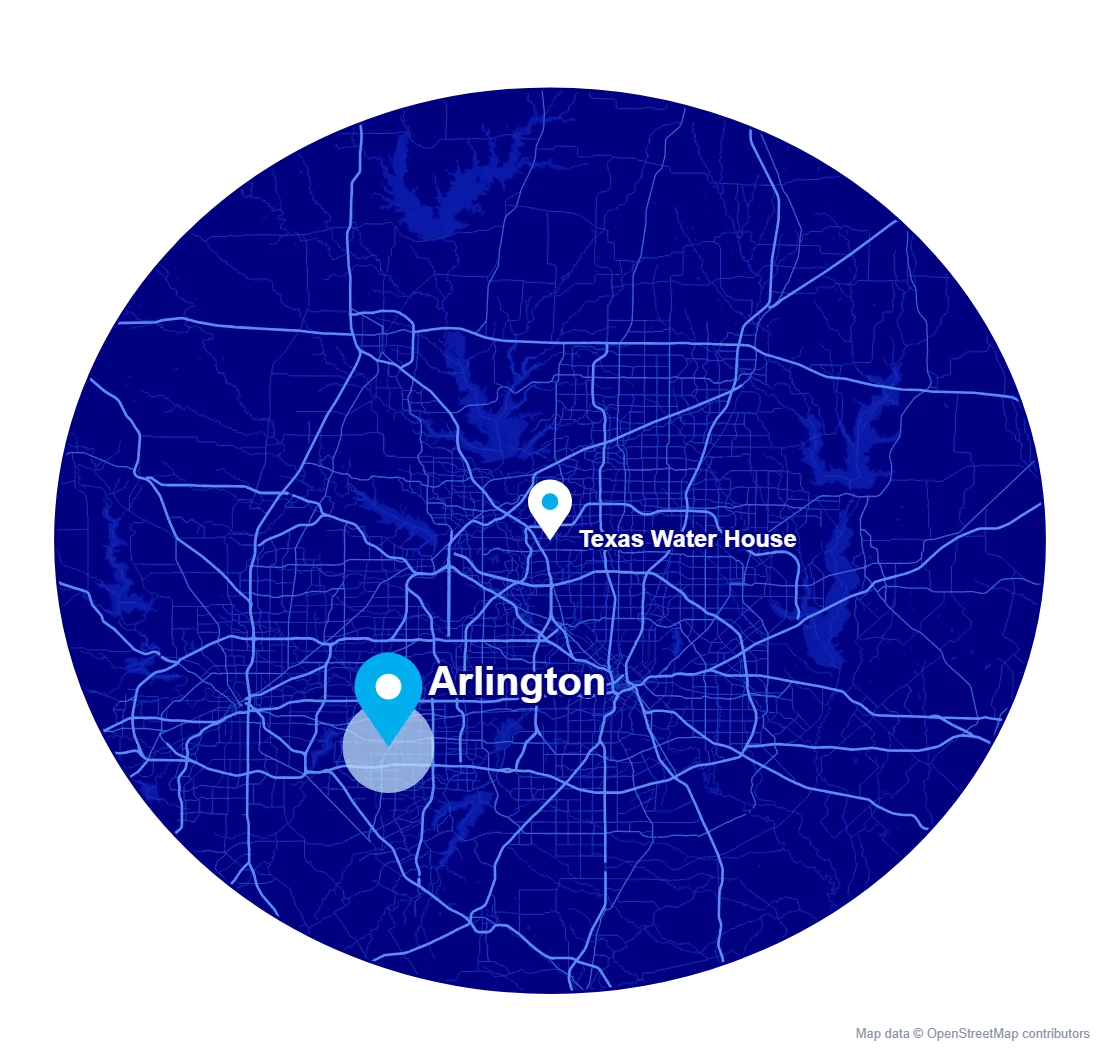
HOW HARD IS ARLINGTON’S WATER?
Full Arlington water report ↗Whole house water filtration in Arlington ↗Bottled water delivery in Arlington ↗Arlington.
94 ppm. That is 5.5 grains per gallon.
The Arlington water quality report lists an average total hardness of 94 ppm, with a reported range of 80.4 to 110 ppm (4.7 to 6.4 grains per gallon). On the USGS hardness scale that is moderately hard water.
COMMON SIGNS OF HARD WATER
What 5.5 grains per gallon looks like at home.
At about 5.5 grains per gallon, every one of these shows up in Arlington sooner or later. The water test tells you how soon.
Cloudy glassware and white spots the dishwasher cannot rinse off: about 5.5 grains of dried mineral per gallon.
The white crust is limescale. It narrows spray holes and seizes aerators and valves.
Calcium and magnesium react with soap before it foams: more soap, and scum on tubs and shower doors.
The same soap curd settles on skin and hair and does not rinse away.
Minerals bind to fabric and detergent. Towels come out stiff, whites go grey, colors fade sooner.
Scale coats heating elements and clogs small valves, so appliances work harder and fail sooner.
ARLINGTON’S WATER, BY HARDNESS
Lake water from the Pierce-Burch and Kubala plants at 94 ppm, moderately hard
Arlington's water is made at two city plants, Pierce-Burch on Lakewood Drive, built in 1972 and rated at 75 million gallons a day, and John F. Kubala, and between them the city says they produce more than 18 billion gallons of tap water a year. The raw water is bought from the Tarrant Regional Water District and comes from four reservoirs: Cedar Creek, Richland-Chambers, Lake Arlington and Lake Benbrook. The district owns the two eastern lakes and uses Arlington and Benbrook as storage, and it moves the eastern water back toward Tarrant County through more than 250 miles of pipeline. The treatment train, as the 2025 report describes it, runs ozone as the primary disinfectant, made on site by converting oxygen, with hydrogen peroxide alongside it, then aluminum sulfate and a cationic polymer to gather particles so they settle, then filtration through beds of granular activated carbon, and chloramine added as the water goes to storage so it stays disinfected out to the taps. The city's laboratory took 7,423 samples and ran 17,388 analyses on the water in 2025. Pierce-Burch is partway through a 112.5 million dollar rebuild of its chemical feed, clearwells and high-service pumps, with two new underground clearwells of 8 million gallons each.
The 2025 report prints total hardness averaging 94 ppm as calcium carbonate, across a range of 80.4 to 110 ppm. That is the figure for the city. The USGS scale puts the whole range in its moderately hard band, which runs from 61 to 120; converted, it is about 5.5 grains per gallon on average, from about 4.7 at the low end to about 6.4 at the top. Nothing in the treatment train changes it. The district says it does no treatment of its raw water for drinking, so the minerals arrive from the lakes, and ozone, coagulation and carbon filtration remove microbes, particles and taste and odor compounds, not dissolved calcium and magnesium. The city's own guidance reflects that: its water-quality page tells residents who want to change the hardness of their water to do their own research into home treatment, and its laboratory offers a hardness test to residents for 32.12 dollars. A reservoir's calcium and magnesium are gathered from its watershed, and the two eastern lakes gather from a great deal of East Texas.
Both plants treat the same district blend, so 94 ppm is Arlington's water across the city, and the 80.4 to 110 swing comes from the lakes and the calendar, not from the neighborhood or the age of the street. At this level the signs at home are modest and familiar: a haze on glassware out of the dishwasher, a white edge on faucets and shower doors, and a gradual coating inside the water heater; these are dissolved minerals, not a contaminant. For a softener, the top of the range is the number that counts: a unit sized for about 6.5 grains covers the hardest month the report recorded, and a metered valve regenerates less often when the blend eases toward 80. Your own tap's reading from the free water test, taken on the day, is the one we size to.
Sources: City of Arlington — 2025 Water Quality Report, joomag viewer · City of Arlington — Pierce-Burch Water Treatment Plant Project · Arlington Water Utilities — Drinking Water Quality Questions · Tarrant Regional Water District — Water Supply · Tarrant Regional Water District — Water Quality
HOW A SOFTENER WORKS
Ion exchange, salt and regeneration.
One tank of resin, one tank of salt, and a valve that runs the cycle.
Resin beads hold sodium ions. Calcium and magnesium swap onto the beads as water passes, and the water leaves at close to zero grains.
When the beads fill up, brine from the salt tank rinses the hardness to the drain and reloads the sodium, metered by the gallons you use.
Calcium, magnesium and a little dissolved iron. Not chlorine, chloramine, PFAS, lead or taste: that is a filter’s job, so see whole house water filtration for Arlington, and a reverse osmosis tap or bottled water delivery for drinking water.
A salt-free water conditioner turns hardness into crystals that stay in the water instead of on heaters and pipes: no salt, no drain, less scale, no relief for soap and skin.
HARDNESS QUESTIONS, ANSWERED
The hard water FAQ for Arlington.
Is Arlington’s water hard?
Moderately. Arlington's 2025 report prints total hardness averaging 94 ppm as calcium carbonate, with a range of 80.4 to 110, which the USGS scale calls moderately hard; that is about 5.5 grains per gallon on average and about 6.4 at the top. The water is Tarrant Regional lake water treated at the city's two plants; the free water test gives the figure at your tap.
Is hard water safe to drink?
Yes. Hardness is calcium and magnesium, minerals with no federal drinking-water limit. It is a plumbing, appliance, soap and skin problem, not a health one.
Does a softener make my water salty?
No. The salt goes down the drain at regeneration; the water carries a little sodium in proportion to the hardness removed, which a reverse osmosis tap removes again.
THE SOURCE MATTERS
Where the number comes from.
Each figure is read from the document linked beside it, in its own units and period. A missing result stays missing; a range stays a range.
Hardness result
Arlington water quality report ↗
2025
City of Arlington · PWS TX2200001
Average level; reported range 80.4–110 ppm
Hardness scale
USGS Water Science School: hardness of water ↗
USGS hardness scale, mg/L as CaCO3: soft 0 to 60; moderately hard 61 to 120; hard 121 to 180; very hard over 180.
FREE WATER TEST IN ARLINGTON
Start with a
free water test.
We measure the hardness at your tap, size the softener in grains to that number, and install it ourselves.