
Whole House Water Softeners in Azle
For over 55 years, Texas Water House has been North Texas’s trusted partner for premium whole house water softener systems. Our custom-designed water softening solutions protect your home’s plumbing, extend appliance life, and deliver silky-soft water to every tap in your home. Whether you’re concerned about hard water, dry skin, or the long-term health of your plumbing system, our whole house water softeners provide comprehensive protection.
Northern Texas
service area
At Texas Water House, we are committed to delivering outstanding water solutions to a wide array of locations across Northern Texas. Our services are designed to meet the unique needs of each community, ensuring access to clean, safe, and high-quality water for both residential and commercial clients. Trust Texas Water House to be your partner in ensuring the highest standards of water quality and service excellence in the greater DFW area.
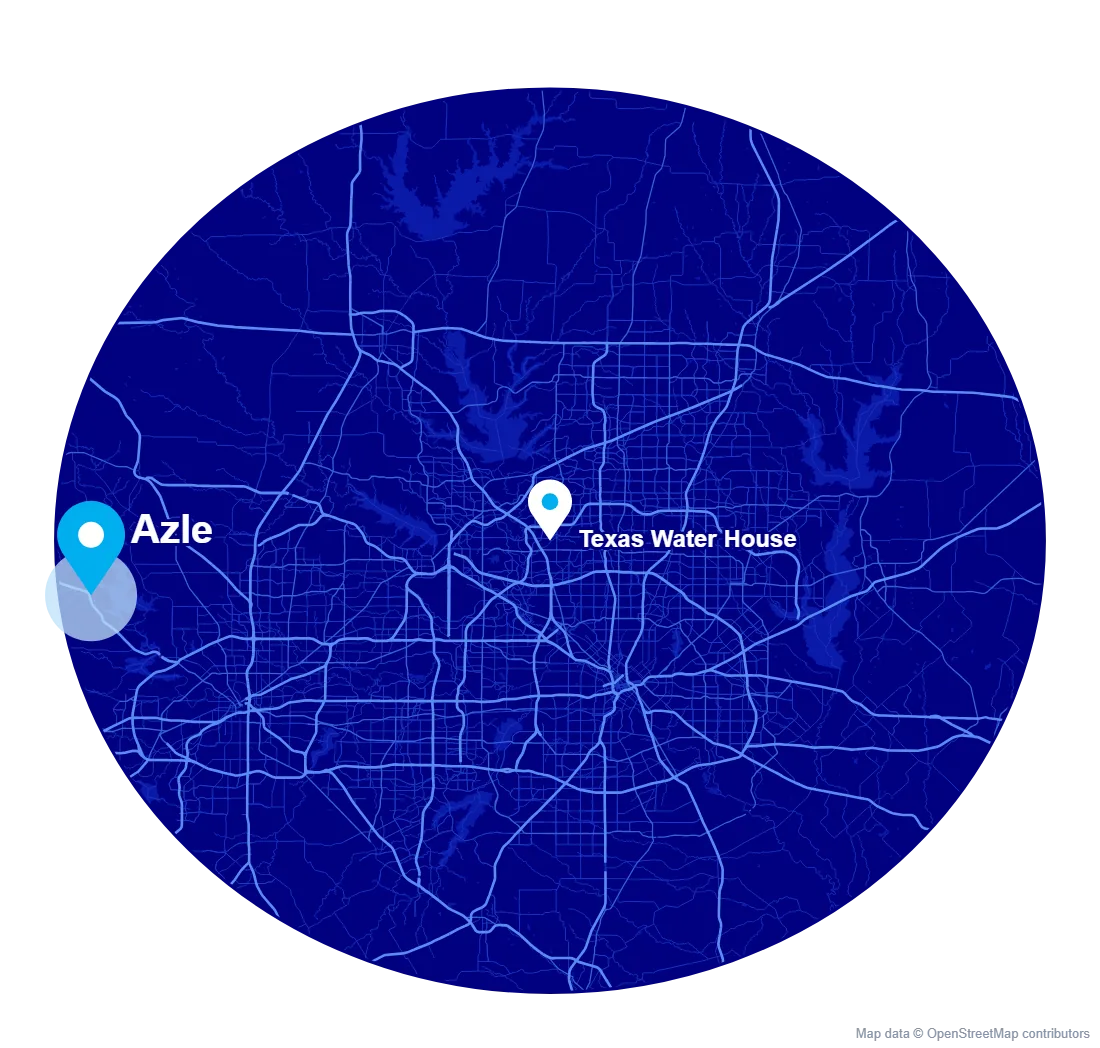
HOW HARD IS AZLE’S WATER?
Full Azle water report ↗Whole house water filtration in Azle ↗Bottled water delivery in Azle ↗Azle.
No hardness figure on file for Azle yet.
Azle treats Eagle Mountain Lake water at its own plant, and while the plant's report describes the water's hardness in words, this page holds no checked figure for Azle yet.
COMMON SIGNS OF HARD WATER
What each grain per gallon looks like at home.
With no figure for Azle, the signs are the measure. Three or more of these, and the free water test will put a number on it.
Cloudy glassware and white spots the dishwasher cannot rinse off: the minerals that dry out of every gallon.
The white crust is limescale. It narrows spray holes and seizes aerators and valves.
Calcium and magnesium react with soap before it foams: more soap, and scum on tubs and shower doors.
The same soap curd settles on skin and hair and does not rinse away.
Minerals bind to fabric and detergent. Towels come out stiff, whites go grey, colors fade sooner.
Scale coats heating elements and clogs small valves, so appliances work harder and fail sooner.
AZLE’S WATER, BY HARDNESS
Eagle Mountain Lake water from the city's own plant, moderately hard, at times hard
Azle runs a full surface water plant of its own. The Azle Water Treatment Plant pulls raw water from Eagle Mountain Lake through a pump station rated at 6 million gallons a day, mixes in treatment chemicals to disinfect and bind particles, settles out the silt, filters through anthracite and sand, disinfects again and adjusts pH, then holds 2.5 million gallons on site before five high service pumps push it into 137 miles of pipe and two elevated tanks holding another 1.5 million gallons. In 2025 the city averaged 2.075 million gallons a day. Eagle Mountain is a Tarrant Regional Water District lake on the West Fork of the Trinity; the plant's report quotes its normal capacity at 190,460 acre-feet, the state's 2018 survey measured 185,087 acre-feet over 9,246 acres, and the district's data is what drives Azle's drought plan and watering rules.
The plant's 2025 report is unusually direct about minerals. It explains that carbonate and bicarbonate compounds of calcium and magnesium are what make water hard, that rain dissolves the limestone in the local soil and carries those minerals into the lake, and that the city's water is, in the plant's own words, moderately hard, rising at times to hard. It adds that treatment does not take hardness out; what the operators control is pH, held in a narrow band so the water neither corrodes metal pipe nor lays down mineral deposits, and that flushing hydrants is partly about clearing mineral buildup from the mains. The report also prints the standard hardness scale, a set of class boundaries rather than readings, in which the moderately hard class spans 60 to 120 mg/L and the hard class 120 to 180, and notes that dishwashers with a hardness setting want the figure in grains per gallon. What this page does not carry is a checked number for Azle: we have not yet confirmed one, so we describe the water as the plant does and leave the figure to the test.
Because the whole city drinks from one plant, there is no blending between sources and no well water in the mix. The differences a homeowner notices are seasonal, as runoff changes what the lake carries, and local, since the report notes that pipe size and material change along the way to the tap and that the system's average pressure is 81 pounds per square inch. Hard here means scale in a water heater and spots on glassware rather than anything to do with safety; the report says the same. A softener for an Azle home should be sized to the upper end of what the plant describes, the hard class, and the free water test gives you the grains figure for your own tap to set it by.
Sources: City of Azle — 2025 Consumer Confidence Report, TX2200002 · Texas Water Development Board — Eagle Mountain Dam and Lake
HOW A SOFTENER WORKS
Ion exchange, salt and regeneration.
One tank of resin, one tank of salt, and a valve that runs the cycle.
Resin beads hold sodium ions. Calcium and magnesium swap onto the beads as water passes, and the water leaves at close to zero grains.
When the beads fill up, brine from the salt tank rinses the hardness to the drain and reloads the sodium, metered by the gallons you use.
Calcium, magnesium and a little dissolved iron. Not chlorine, chloramine, PFAS, lead or taste: that is a filter’s job, so see whole house water filtration for Azle, and a reverse osmosis tap or bottled water delivery for drinking water.
A salt-free water conditioner turns hardness into crystals that stay in the water instead of on heaters and pipes: no salt, no drain, less scale, no relief for soap and skin.
HARDNESS QUESTIONS, ANSWERED
The hard water FAQ for Azle.
Is Azle’s water hard?
Azle's own water treatment plant describes the city's water as moderately hard, rising at times to hard, with calcium and magnesium washed into Eagle Mountain Lake from the limestone soil around it. We do not yet carry a checked figure for Azle, so the free water test is how to get the number in grains for your tap, and the hard class is the end to size a softener for.
Is hard water safe to drink?
Yes. Hardness is calcium and magnesium, minerals with no federal drinking-water limit. It is a plumbing, appliance, soap and skin problem, not a health one.
Does a softener make my water salty?
No. The salt goes down the drain at regeneration; the water carries a little sodium in proportion to the hardness removed, which a reverse osmosis tap removes again.
THE SOURCE MATTERS
Where the number comes from.
Each figure is read from the document linked beside it, in its own units and period. A missing result stays missing; a range stays a range.
Hardness result
None on file for Azle.
Utility of record: City of Azle · PWS TX2200002
Checked: EWG Tap Water Database entry ↗ (2021-2023), City of Azle water quality report ↗ (2025). They hold 7 results for Azle: Haloacetic acids (HAA5) 18 ppb; Total trihalomethanes (TTHMs) 25.9 ppb; Chloramines 2.89 ppm; Lead — 90th percentile 2.22 ppb; Perfluorobutanoic acid (PFBA) 0.0055 ppb; Perfluorooctane sulfonate (PFOS) not detected; Perfluorooctanoic acid (PFOA) not detected. None is a hardness result.
Hardness scale
USGS Water Science School: hardness of water ↗
USGS hardness scale, mg/L as CaCO3: soft 0 to 60; moderately hard 61 to 120; hard 121 to 180; very hard over 180.
FREE WATER TEST IN AZLE
Start with a
free water test.
We measure the hardness at your tap, size the softener in grains to that number, and install it ourselves.