
Whole House Water Softeners in Newark
For over 55 years, Texas Water House has been North Texas’s trusted partner for premium whole house water softener systems. Our custom-designed water softening solutions protect your home’s plumbing, extend appliance life, and deliver silky-soft water to every tap in your home. Whether you’re concerned about hard water, dry skin, or the long-term health of your plumbing system, our whole house water softeners provide comprehensive protection.
Northern Texas
service area
At Texas Water House, we are committed to delivering outstanding water solutions to a wide array of locations across Northern Texas. Our services are designed to meet the unique needs of each community, ensuring access to clean, safe, and high-quality water for both residential and commercial clients. Trust Texas Water House to be your partner in ensuring the highest standards of water quality and service excellence in the greater DFW area.
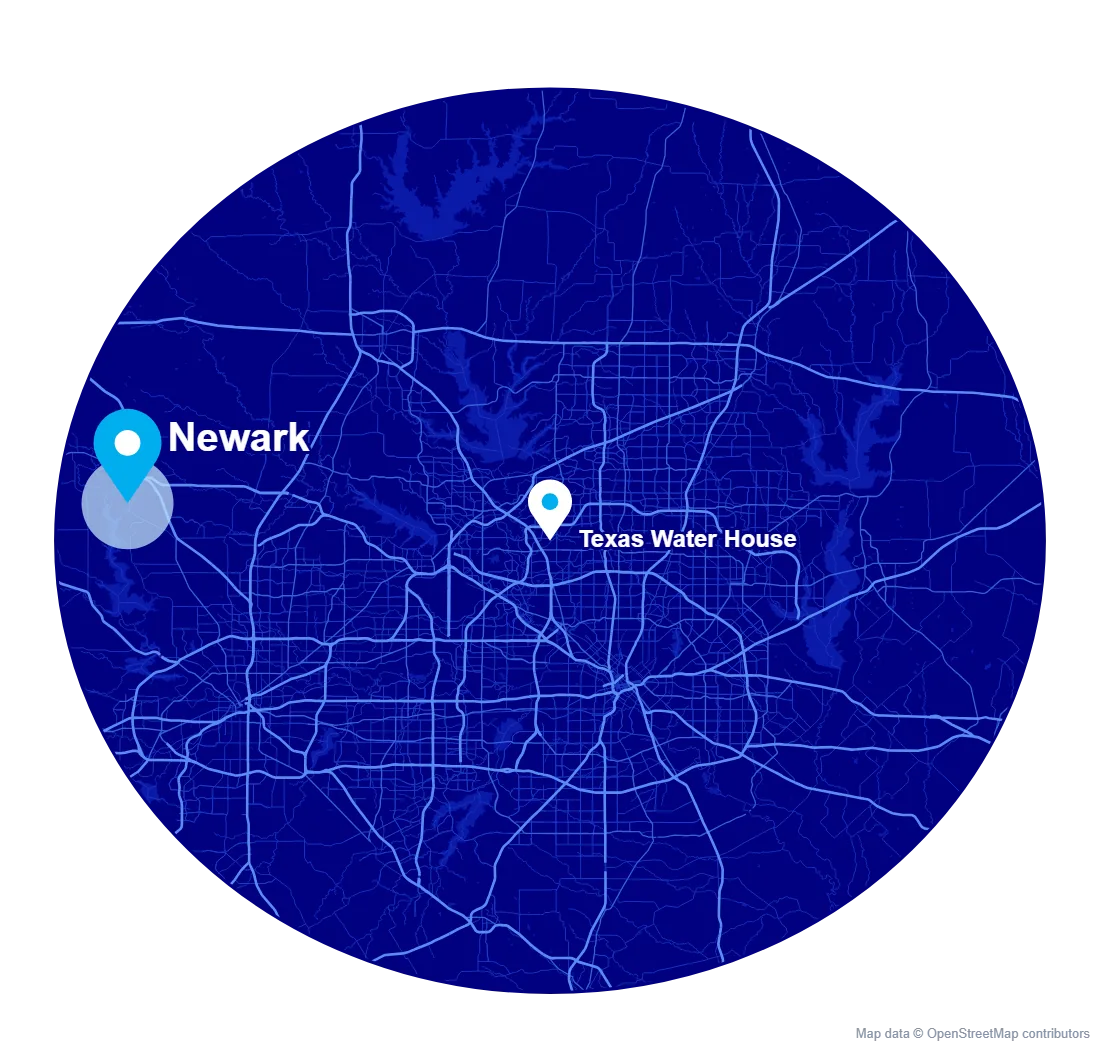
HOW HARD IS NEWARK’S WATER?
Full Newark water report ↗Whole house water filtration in Newark ↗Bottled water delivery in Newark ↗Newark.
No hardness figure on file for Newark yet.
Newark pumps all of its water from city wells in the Trinity Aquifer, and the results pages of its 2025 report are scanned images we could not read for a hardness figure.
COMMON SIGNS OF HARD WATER
What each grain per gallon looks like at home.
With no figure for Newark, the signs are the measure. Three or more of these, and the free water test will put a number on it.
Cloudy glassware and white spots the dishwasher cannot rinse off: the minerals that dry out of every gallon.
The white crust is limescale. It narrows spray holes and seizes aerators and valves.
Calcium and magnesium react with soap before it foams: more soap, and scum on tubs and shower doors.
The same soap curd settles on skin and hair and does not rinse away.
Minerals bind to fabric and detergent. Towels come out stiff, whites go grey, colors fade sooner.
Scale coats heating elements and clogs small valves, so appliances work harder and fail sooner.
NEWARK’S WATER, BY HARDNESS
Trinity Aquifer well water from nine city sources, with no readable hardness figure
Newark's 2025 Consumer Confidence Report classifies the city as a groundwater system and lists nine sources, clustered at Hudson Street and Ramhorn Road, at FM 718 by City Hall, at a second pump station east of Ram Horn Road and on the west side of Rose Hill, all administered from 209 Hudson Street; nothing on the readable page suggests purchased water or a surface source. The state's January 2024 Wise County summary names the Trinity Aquifer as the city's only supply and puts Newark on its list of systems under 7,500 people that rely on a single source, alongside Alvord, Bridgeport, Decatur, Runaway Bay and West Wise SUD. The same summary expects Newark's unmet need to grow from 36 percent of demand in 2020 to 85 percent by 2070, and lists more wells, aquifer storage and recovery, conservation and other surface water as the ways to close it. For now, every drop is Trinity water.
The Trinity Aquifer under Wise County is the same stack of sands and limestones that supplies wells from here to Central Texas, and the Water Development Board's account of its chemistry is the best guide we have to Newark's hardness. The board counts 61 counties over the aquifer and notes that about 88 percent of it lies inside groundwater conservation districts, where pumping is managed. At the outcrop the water is fresh but very hard. Downdip, as depth increases, total dissolved solids rise past 1,000 milligrams per liter and can reach 5,000, and sulfate and chloride rise with them. So a Trinity well can deliver very hard water or heavily mineralized water depending on where it is finished, and only a secondary constituents table can say which. Newark's report may contain one: pages 2 through 5 of the 2025 document are scanned images, and the one page whose text can be read is the source list, so whether a total hardness figure is printed there cannot be confirmed. This page therefore carries no figure for Newark and will not guess one.
What a Newark household can count on is groundwater behavior. Well water does not follow the seasons the way lake water does, so a hardness figure measured at your tap tends to stay put, and the blend you receive depends on which of the nine sources are running rather than on the month. Homes on the Rose Hill side and homes near Hudson Street may be fed by different wells. As the city grows, the state plan expects more wells, which can shift the blend again. A free water test is how to get the number for your address, and it is the number to size a softener to; with no printed range to lean on, size to your test, not to a neighbor's.
Sources: City of Newark — 2025 Consumer Confidence Report, TX2490008 · Texas Water Development Board — Wise County Summary, January 2024 · Texas Water Development Board — Trinity Aquifer
HOW A SOFTENER WORKS
Ion exchange, salt and regeneration.
One tank of resin, one tank of salt, and a valve that runs the cycle.
Resin beads hold sodium ions. Calcium and magnesium swap onto the beads as water passes, and the water leaves at close to zero grains.
When the beads fill up, brine from the salt tank rinses the hardness to the drain and reloads the sodium, metered by the gallons you use.
Calcium, magnesium and a little dissolved iron. Not chlorine, chloramine, PFAS, lead or taste: that is a filter’s job, so see whole house water filtration for Newark, and a reverse osmosis tap or bottled water delivery for drinking water.
A salt-free water conditioner turns hardness into crystals that stay in the water instead of on heaters and pipes: no salt, no drain, less scale, no relief for soap and skin.
HARDNESS QUESTIONS, ANSWERED
The hard water FAQ for Newark.
Is Newark’s water hard?
We cannot say with a number. Newark's water is groundwater from city wells in the Trinity Aquifer, very hard at the outcrop by the state's description, with dissolved solids rising downdip, and the results pages of the city's 2025 report are scanned images we could not read for a hardness figure. A free water test gives the number for a Newark tap.
Is hard water safe to drink?
Yes. Hardness is calcium and magnesium, minerals with no federal drinking-water limit. It is a plumbing, appliance, soap and skin problem, not a health one.
Does a softener make my water salty?
No. The salt goes down the drain at regeneration; the water carries a little sodium in proportion to the hardness removed, which a reverse osmosis tap removes again.
THE SOURCE MATTERS
Where the number comes from.
Each figure is read from the document linked beside it, in its own units and period. A missing result stays missing; a range stays a range.
Hardness result
None on file for Newark.
Utility of record: City of Newark · PWS TX2490008
Checked: EWG Tap Water Database entry ↗ (2021-2023), City of Newark water quality report ↗ (2025). They hold 4 results for Newark: Haloacetic acids (HAA5) 3 ppb; Total trihalomethanes (TTHMs) 16.3 ppb; Chlorine residual 1.08 ppm; Lead — 90th percentile not detected. None is a hardness result.
Hardness scale
USGS Water Science School: hardness of water ↗
USGS hardness scale, mg/L as CaCO3: soft 0 to 60; moderately hard 61 to 120; hard 121 to 180; very hard over 180.
FREE WATER TEST IN NEWARK
Start with a
free water test.
We measure the hardness at your tap, size the softener in grains to that number, and install it ourselves.