
Whole House Water Softeners in Pelican Bay
For over 55 years, Texas Water House has been North Texas’s trusted partner for premium whole house water softener systems. Our custom-designed water softening solutions protect your home’s plumbing, extend appliance life, and deliver silky-soft water to every tap in your home. Whether you’re concerned about hard water, dry skin, or the long-term health of your plumbing system, our whole house water softeners provide comprehensive protection.
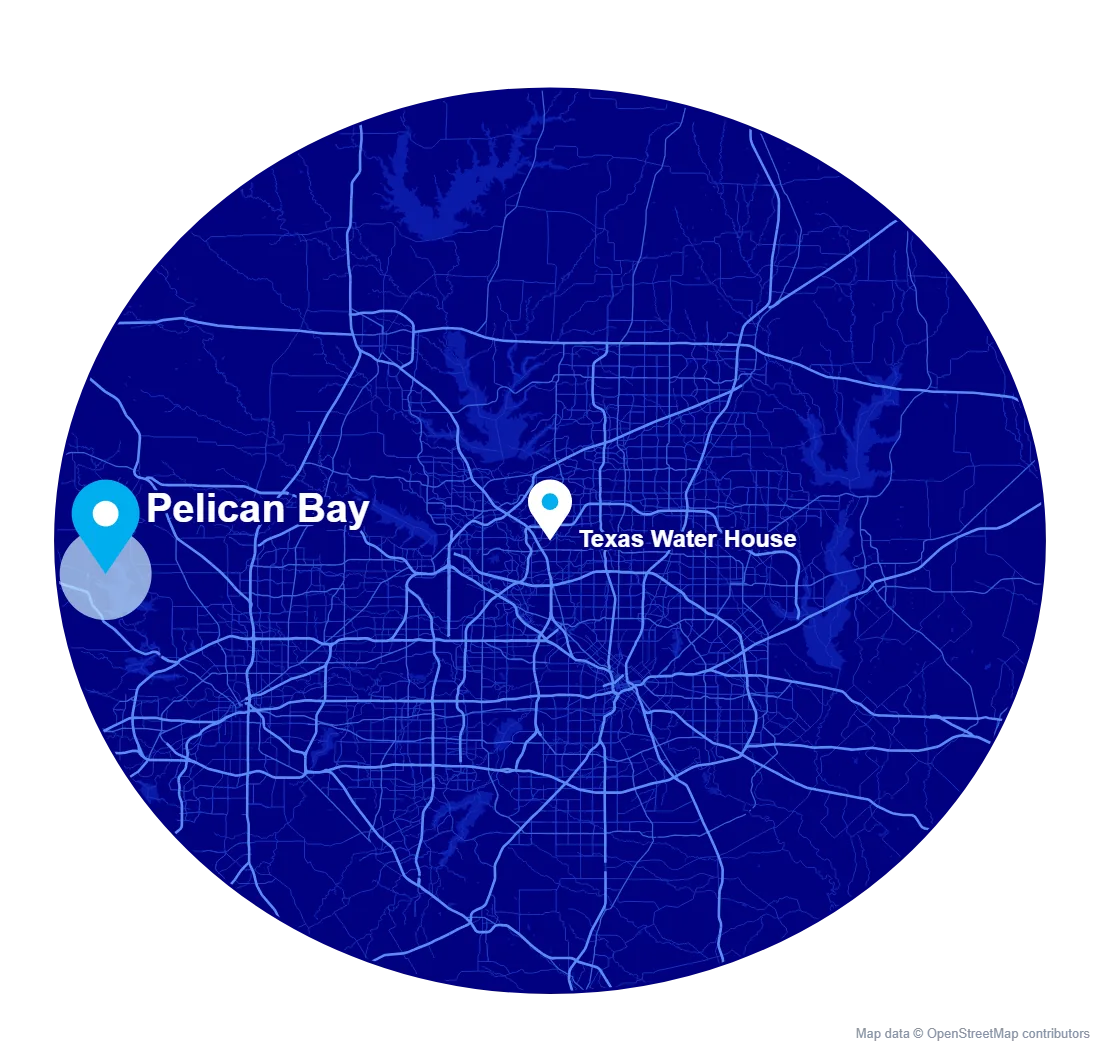
Northern Texas
service area
At Texas Water House, we are committed to delivering outstanding water solutions to a wide array of locations across Northern Texas. Our services are designed to meet the unique needs of each community, ensuring access to clean, safe, and high-quality water for both residential and commercial clients. Trust Texas Water House to be your partner in ensuring the highest standards of water quality and service excellence in the greater DFW area.
HOW HARD IS PELICAN BAY’S WATER?
Full Pelican Bay water report ↗Whole house water filtration in Pelican Bay ↗Bottled water delivery in Pelican Bay ↗Pelican Bay.
No hardness figure on file for Pelican Bay yet.
Pelican Bay pumps its water from city wells in the Trinity and Woodbine aquifers, and its 2025 report prints no hardness figure we could read.
COMMON SIGNS OF HARD WATER
What each grain per gallon looks like at home.
With no figure for Pelican Bay, the signs are the measure. Three or more of these, and the free water test will put a number on it.
Cloudy glassware and white spots the dishwasher cannot rinse off: the minerals that dry out of every gallon.
The white crust is limescale. It narrows spray holes and seizes aerators and valves.
Calcium and magnesium react with soap before it foams: more soap, and scum on tubs and shower doors.
The same soap curd settles on skin and hair and does not rinse away.
Minerals bind to fabric and detergent. Towels come out stiff, whites go grey, colors fade sooner.
Scale coats heating elements and clogs small valves, so appliances work harder and fail sooner.
PELICAN BAY’S WATER, BY HARDNESS
Well water from two stacked aquifers, Woodbine over Trinity, with no printed figure
Pelican Bay sits on Eagle Mountain Lake and drinks none of it. Its public works page describes the city as operating multiple wells, with an emergency connection to Azle's water system as the only lake water in the picture, held in reserve for outages. The wells tap two different formations. The Woodbine is a minor aquifer of sandstone interbedded with shale and clay that lies on top of the Trinity across northeast Texas, forming three water-bearing zones, up to 600 feet thick below ground, with fresh water to a depth of about 1,500 feet. Below it is the Trinity, the major aquifer under most of North Texas, whose named sands include the Paluxy and Twin Mountains. The city's 2025 report labels each well by its aquifer: the Woodbine wells are at the 92-acre tract and on Pelican Drive and Pelican Oval, and the Trinity wells on Liberty School Road, Jason Court, Yacht Club Drive and at the compound and pump station sites, so a Pelican Bay tap can carry Woodbine water, Trinity water or both, depending on which pumps are running.
The two aquifers do not promise the same water. The Water Development Board says Woodbine water is fresh, under 1,000 milligrams per liter of dissolved solids, down to about 1,500 feet, becoming slightly to moderately saline below that, and that the upper zone tends to run very high in iron, which stains fixtures but is not hardness. For the Trinity, the board describes water that is fresh but very hard at the outcrop and more mineralized with depth, with total dissolved solids rising from under 1,000 to between 1,000 and 5,000 milligrams per liter downdip. Pelican Bay's own report prints no table of secondary constituents: no total hardness, no calcium or magnesium, no sodium. The city's report does print fluoride at 0.868 to 1.42 ppm and barium up to 0.071 ppm, both attributed in part to erosion of natural deposits, which tells you the water has been in contact with mineral rock, not how hard it is. We will not turn either aquifer's general description into a number for this city.
What a homeowner can expect is a groundwater pattern: little seasonal swing, since wells do not follow rain and lake level the way a reservoir does, but a possible difference between neighborhoods, since different well sites feed different parts of a small system and the Woodbine and Trinity wells are not evenly spread across it. Which aquifer dominates at your address decides what you see on your fixtures. The state's county summary lists more wells, reuse, conservation and other surface water among Pelican Bay's strategies to 2070, so lake water could one day join the mix, but today it is wells. A free water test settles the question for your tap, and the result is the number to size a softener to, rather than any figure borrowed from the lake next door.
Sources: City of Pelican Bay — 2025 Consumer Confidence Report, TX2200164 · City of Pelican Bay — Public Works / Water Department · Texas Water Development Board — Woodbine Aquifer · Texas Water Development Board — Trinity Aquifer · Texas Water Development Board — Tarrant County Summary, January 2024
HOW A SOFTENER WORKS
Ion exchange, salt and regeneration.
One tank of resin, one tank of salt, and a valve that runs the cycle.
Resin beads hold sodium ions. Calcium and magnesium swap onto the beads as water passes, and the water leaves at close to zero grains.
When the beads fill up, brine from the salt tank rinses the hardness to the drain and reloads the sodium, metered by the gallons you use.
Calcium, magnesium and a little dissolved iron. Not chlorine, chloramine, PFAS, lead or taste: that is a filter’s job, so see whole house water filtration for Pelican Bay, and a reverse osmosis tap or bottled water delivery for drinking water.
A salt-free water conditioner turns hardness into crystals that stay in the water instead of on heaters and pipes: no salt, no drain, less scale, no relief for soap and skin.
HARDNESS QUESTIONS, ANSWERED
The hard water FAQ for Pelican Bay.
Is Pelican Bay’s water hard?
No published number exists. Pelican Bay's wells draw from two aquifers, the Woodbine and the Trinity, and the city's 2025 report prints no table of secondary constituents. The state's descriptions, very hard Trinity water at the outcrop and iron-heavy water in the Woodbine's upper zone, point to minerals without giving a figure, so a free water test is the way to learn your tap's hardness.
Is hard water safe to drink?
Yes. Hardness is calcium and magnesium, minerals with no federal drinking-water limit. It is a plumbing, appliance, soap and skin problem, not a health one.
Does a softener make my water salty?
No. The salt goes down the drain at regeneration; the water carries a little sodium in proportion to the hardness removed, which a reverse osmosis tap removes again.
THE SOURCE MATTERS
Where the number comes from.
Each figure is read from the document linked beside it, in its own units and period. A missing result stays missing; a range stays a range.
Hardness result
None on file for Pelican Bay.
Utility of record: City of Pelican Bay · PWS TX2200164
Checked: EWG Tap Water Database entry ↗ (2021-2023), City of Pelican Bay water quality report ↗ (2025). They hold 4 results for Pelican Bay: Haloacetic acids (HAA5) 4.57 ppb; Total trihalomethanes (TTHMs) 10.3 ppb; Free chlorine 1 mg/L; Lead — 90th percentile 1.7 ppb. None is a hardness result.
Hardness scale
USGS Water Science School: hardness of water ↗
USGS hardness scale, mg/L as CaCO3: soft 0 to 60; moderately hard 61 to 120; hard 121 to 180; very hard over 180.
FREE WATER TEST IN PELICAN BAY
Start with a
free water test.
We measure the hardness at your tap, size the softener in grains to that number, and install it ourselves.