
Whole House Water Softeners in Terrell
For over 55 years, Texas Water House has been North Texas’s trusted partner for premium whole house water softener systems. Our custom-designed water softening solutions protect your home’s plumbing, extend appliance life, and deliver silky-soft water to every tap in your home. Whether you’re concerned about hard water, dry skin, or the long-term health of your plumbing system, our whole house water softeners provide comprehensive protection.
Northern Texas
service area
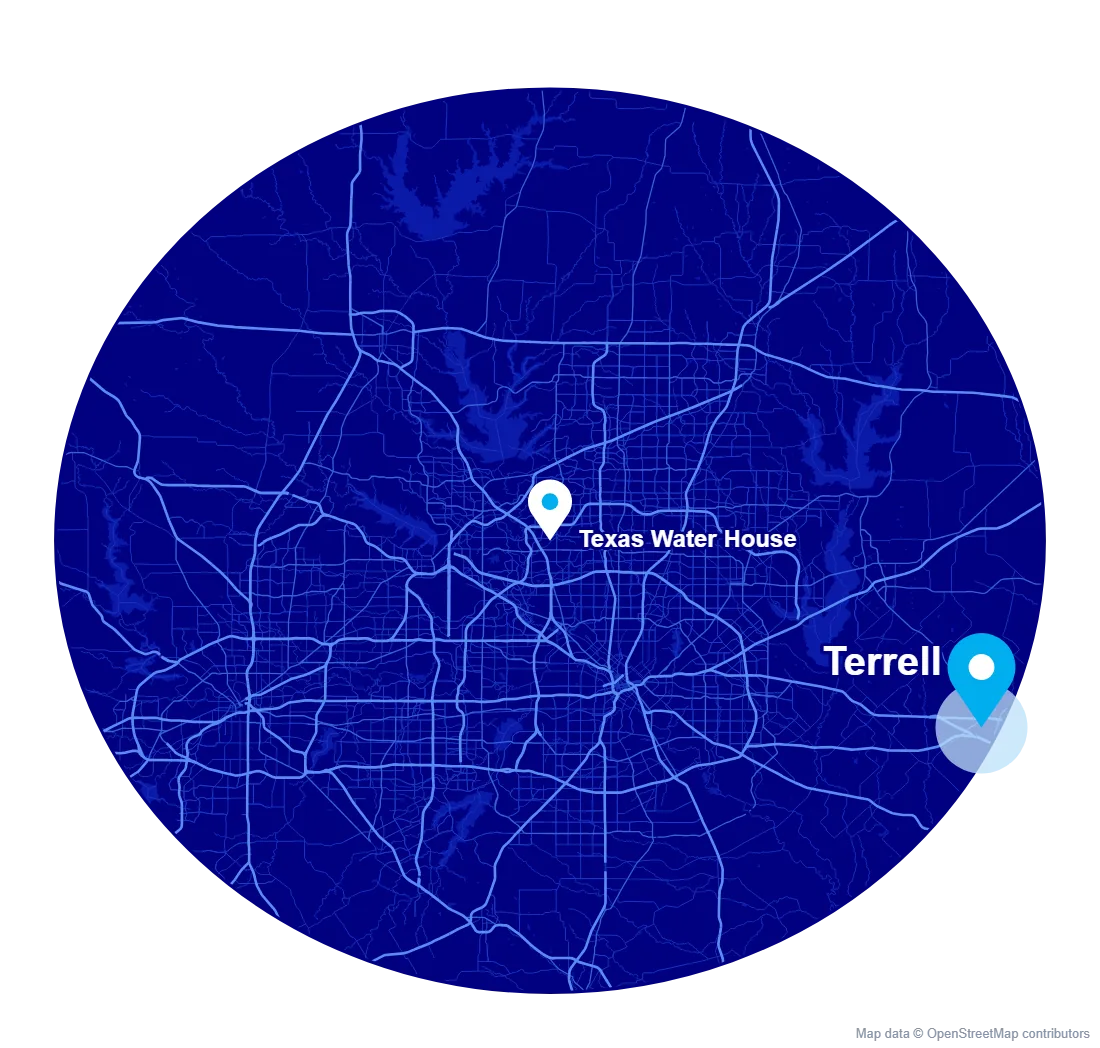
At Texas Water House, we are committed to delivering outstanding water solutions to a wide array of locations across Northern Texas. Our services are designed to meet the unique needs of each community, ensuring access to clean, safe, and high-quality water for both residential and commercial clients. Trust Texas Water House to be your partner in ensuring the highest standards of water quality and service excellence in the greater DFW area.
HOW HARD IS TERRELL’S WATER?
Full Terrell water report ↗Whole house water filtration in Terrell ↗Bottled water delivery in Terrell ↗Terrell.
No hardness figure on file for Terrell yet.
Terrell buys treated water from the North Texas Municipal Water District, mainly from its Lake Tawakoni plant, and the city's own report prints no hardness figure.
COMMON SIGNS OF HARD WATER
What each grain per gallon looks like at home.
With no figure for Terrell, the signs are the measure. Three or more of these, and the free water test will put a number on it.
Cloudy glassware and white spots the dishwasher cannot rinse off: the minerals that dry out of every gallon.
The white crust is limescale. It narrows spray holes and seizes aerators and valves.
Calcium and magnesium react with soap before it foams: more soap, and scum on tubs and shower doors.
The same soap curd settles on skin and hair and does not rinse away.
Minerals bind to fabric and detergent. Towels come out stiff, whites go grey, colors fade sooner.
Scale coats heating elements and clogs small valves, so appliances work harder and fail sooner.
TERRELL’S WATER, BY HARDNESS
Tawakoni plant water from the district, no city figure printed
Terrell is unusual among the district's cities in that its water comes first from Lake Tawakoni rather than Lavon Lake. The city's 2025 Consumer Confidence Report names Lake Tawakoni as the primary source and Lavon Lake as the secondary one, and the North Texas Municipal Water District's own 2025 report lists the City of Terrell among nine systems that receive water from its Tawakoni Water Treatment Plant, a plant that began operating in 2011 on water the district holds rights to through a Sabine River Authority contract. The city's water page describes what happens after the water arrives: more than 800,000 linear feet of pipe from 2 to 30 inches across, two water towers holding 2.5 million gallons together and a 3.0 million gallon ground storage tank, staff monitoring up to 10.0 million gallons a day, and monthly samples from twenty locations around town. Terrell also sells water on to six smaller systems, Elmo WSC, College Mound SUD, North Kaufman WSC, Lawrence WSC, High Point SUD and Poetry SUD. The city once had a lake of its own: a 2010 study for the Texas Water Development Board records that Terrell holds a water right dating to 1954 on New Terrell City Lake, on Muddy Cedar Creek, but no longer uses it for supply.
The district applies one label, moderately hard, to all the water it treats, but its two plants do not print the same numbers. In the district's 2025 report the Tawakoni plant table shows total hardness as calcium carbonate at 60.0 to 249 ppm, with calcium 24.6 to 47.3 ppm, magnesium 2.52 ppm, sodium 14.2 to 37.2 ppm, total alkalinity 52.0 to 75.2 ppm and total dissolved solids 175 to 264 ppm. The district's Wylie plant table in the same report, the Lavon supply that backs Terrell up, shows 96.0 to 200 ppm hardness with 182 to 455 ppm dissolved solids. The district's Tawakoni water, in other words, carries fewer dissolved solids overall but swung further on hardness in its 2025 table, from the soft end of the USGS scale at 60 ppm to very hard at 249. By the district's 17.12 divisor that is roughly 3.5 to 14.5 grains per gallon. These are the plant's figures, attributed to the district; they are not a measurement of Terrell's mains.
No hardness figure appears anywhere in Terrell's own report, so this page carries none for the city. The city posts the district's Tawakoni plant data file beside its report for anyone who wants the plant's full table, and its Superior rating from the state covers compliance, not minerals. What a Terrell household can take from this is that its water is lake water that can land almost anywhere on the hardness scale depending on the month and on whether the Tawakoni or the Lavon supply is flowing, and that the city's twenty monthly sampling points exist to monitor compliance, with hardness not among the results it prints. A softener in Terrell is sized to what your own tap shows at its highest, and a free water test on your own tap supplies that number, in ppm and grains per gallon.
Sources: City of Terrell: 2025 Consumer Confidence Report · City of Terrell: Water · North Texas Municipal Water District: 2025 Water Quality Report · North Texas Municipal Water District: History · North Texas Municipal Water District: Water Quality · Texas Water Development Board contracted report: New Terrell City Lake Water Supply Facility Plan
HOW A SOFTENER WORKS
Ion exchange, salt and regeneration.
One tank of resin, one tank of salt, and a valve that runs the cycle.
Resin beads hold sodium ions. Calcium and magnesium swap onto the beads as water passes, and the water leaves at close to zero grains.
When the beads fill up, brine from the salt tank rinses the hardness to the drain and reloads the sodium, metered by the gallons you use.
Calcium, magnesium and a little dissolved iron. Not chlorine, chloramine, PFAS, lead or taste: that is a filter’s job, so see whole house water filtration for Terrell, and a reverse osmosis tap or bottled water delivery for drinking water.
A salt-free water conditioner turns hardness into crystals that stay in the water instead of on heaters and pipes: no salt, no drain, less scale, no relief for soap and skin.
HARDNESS QUESTIONS, ANSWERED
The hard water FAQ for Terrell.
Is Terrell’s water hard?
We have no figure for Terrell. The city buys treated water from the North Texas Municipal Water District, mainly from its Tawakoni plant, which the district's 2025 report shows at 60.0 to 249 ppm total hardness, soft to very hard. Terrell's own report prints no hardness number, so the free water test gives yours.
Is hard water safe to drink?
Yes. Hardness is calcium and magnesium, minerals with no federal drinking-water limit. It is a plumbing, appliance, soap and skin problem, not a health one.
Does a softener make my water salty?
No. The salt goes down the drain at regeneration; the water carries a little sodium in proportion to the hardness removed, which a reverse osmosis tap removes again.
THE SOURCE MATTERS
Where the number comes from.
Each figure is read from the document linked beside it, in its own units and period. A missing result stays missing; a range stays a range.
Hardness result
None on file for Terrell.
Utility of record: City of Terrell · PWS TX1290006
Checked: EWG Tap Water Database entry ↗ (2013-2024), City of Terrell water quality report ↗ (2025). They hold 10 results for Terrell: Haloacetic acids (HAA5) 18.7 ppb; Perfluorohexane sulfonate (PFHXS) 2.9 ppt; Perfluorooctane sulfonate (PFOS) 7.23 ppt; Total trihalomethanes (TTHMs) 38.3 ppb; Perfluorobutane sulfonate (PFBS) 1.45 ppt; Perfluorobutanoic Acid (PFBA) 7.65 ppt; Perfluorohexanoic Acid (PFHxA) 4.78 ppt; Perfluoropentanoic Acid (PFPeA) 2.88 ppt; Chlorine residual 3.27 ppm; Lead — 90th percentile 2.04 ppb. None is a hardness result.
Hardness scale
USGS Water Science School: hardness of water ↗
USGS hardness scale, mg/L as CaCO3: soft 0 to 60; moderately hard 61 to 120; hard 121 to 180; very hard over 180.
FREE WATER TEST IN TERRELL
Start with a
free water test.
We measure the hardness at your tap, size the softener in grains to that number, and install it ourselves.