
Whole House Water Softeners in Valley View
For over 55 years, Texas Water House has been North Texas’s trusted partner for premium whole house water softener systems. Our custom-designed water softening solutions protect your home’s plumbing, extend appliance life, and deliver silky-soft water to every tap in your home. Whether you’re concerned about hard water, dry skin, or the long-term health of your plumbing system, our whole house water softeners provide comprehensive protection.
Northern Texas
service area
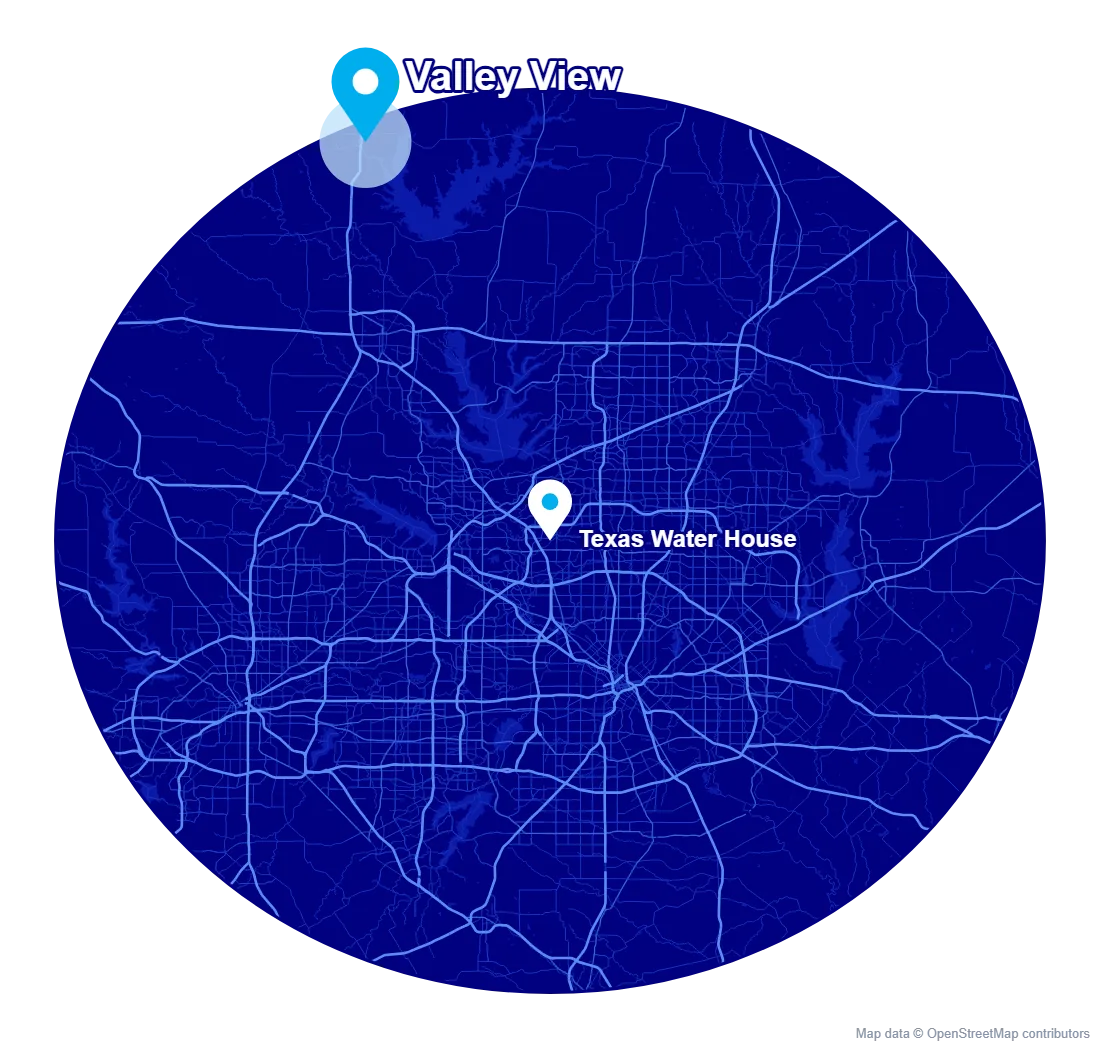
At Texas Water House, we are committed to delivering outstanding water solutions to a wide array of locations across Northern Texas. Our services are designed to meet the unique needs of each community, ensuring access to clean, safe, and high-quality water for both residential and commercial clients. Trust Texas Water House to be your partner in ensuring the highest standards of water quality and service excellence in the greater DFW area.
HOW HARD IS VALLEY VIEW’S WATER?
Full Valley View water report ↗Whole house water filtration in Valley View ↗Bottled water delivery in Valley View ↗Valley View.
No hardness figure on file for Valley View yet.
Valley View pumps all of its water from city wells in the Antlers sand of the Trinity aquifer, and its 2025 water quality report prints no hardness figure.
COMMON SIGNS OF HARD WATER
What each grain per gallon looks like at home.
With no figure for Valley View, the signs are the measure. Three or more of these, and the free water test will put a number on it.
Cloudy glassware and white spots the dishwasher cannot rinse off: the minerals that dry out of every gallon.
The white crust is limescale. It narrows spray holes and seizes aerators and valves.
Calcium and magnesium react with soap before it foams: more soap, and scum on tubs and shower doors.
The same soap curd settles on skin and hair and does not rinse away.
Minerals bind to fabric and detergent. Towels come out stiff, whites go grey, colors fade sooner.
Scale coats heating elements and clogs small valves, so appliances work harder and fail sooner.
VALLEY VIEW’S WATER, BY HARDNESS
Antlers well water pumped since 1912, soft by the state's account, no published figure
Valley View has been a well town for more than a century. The Water Development Board's 1982 report on the Cretaceous aquifers of north-central Texas records that Gainesville and Valley View had wells producing from the Antlers by 1912 and that by 1940 most of the larger towns in Cooke County and western Grayson County were drawing on the same formation; Cooke County was the second-largest public-supply user of the Antlers in 1976, at 2,803 acre-feet. The city's 2025 report lists two supply wells; the state well index shows one of them, drilled in 1935 to 817 feet, as a public-supply well in the Antlers Sand, with the 1912 well, 400 feet deep, now unused. The 2007 state groundwater study for the region lists Valley View's supply as 78 acre-feet a year from the Trinity aquifer and records that a regional plan at the time proposed treated Moss Lake water from Gainesville for Valley View and its neighbors; the city's 2025 report still shows groundwater only.
The Antlers gives two kinds of water depending on where a well sits. The board's 1982 report describes water from the outcrop as mostly hard to very hard with high iron, and water from downdip locations as generally soft; about a third of its Antlers analyses exceeded 60 mg/L of hardness, with the hardest, over 300 mg/L, in Montague and northern Wise counties. The state's sample from Valley View's 817-foot well in October 2003 shows which kind the city has: 178 mg/L of sodium, 364 mg/L of total alkalinity, 444 mg/L of total dissolved solids, chloride of only 4.17 mg/L, and calcium and magnesium at 0.86 and 0.31 mg/L. An August 1999 sample read 178 sodium, 342 alkalinity and 433 dissolved solids, so the water has held steady. Sodium bicarbonate water with almost no calcium is the downdip profile the report describes. The city's own report prints no hardness result, and we will not supply one from a 2003 well sample, so this page carries no figure for Valley View.
At a Valley View tap, the dissolved minerals arrive mostly as sodium and bicarbonate, which do not form the chalky scale lake-water towns see. With two wells in the same sand feeding one small system, the water should be much the same from one street to the next, and the state's repeated samples suggest it changes little from year to year. What a homeowner here should weigh is sodium: a softener adds more of it in exchange for whatever calcium and magnesium are present, and on this water that trade may buy very little. The free water test gives the actual hardness at your tap, and we size to that number or tell you plainly if it does not call for a softener.
Sources: City of Valley View 2025 Consumer Confidence Report · Texas Water Development Board, Groundwater Database well index · Texas Water Development Board, Groundwater Database download · TWDB Report 269, Occurrence, Availability · TCEQ, Priority Groundwater Management Area report for north-central Texas · EPA Envirofacts SDWIS, water system record record for TX0490049 City of Valley View · EPA Envirofacts SDWIS, water system facility records records for TX0490049 City of Valley View
HOW A SOFTENER WORKS
Ion exchange, salt and regeneration.
One tank of resin, one tank of salt, and a valve that runs the cycle.
Resin beads hold sodium ions. Calcium and magnesium swap onto the beads as water passes, and the water leaves at close to zero grains.
When the beads fill up, brine from the salt tank rinses the hardness to the drain and reloads the sodium, metered by the gallons you use.
Calcium, magnesium and a little dissolved iron. Not chlorine, chloramine, PFAS, lead or taste: that is a filter’s job, so see whole house water filtration for Valley View, and a reverse osmosis tap or bottled water delivery for drinking water.
A salt-free water conditioner turns hardness into crystals that stay in the water instead of on heaters and pipes: no salt, no drain, less scale, no relief for soap and skin.
HARDNESS QUESTIONS, ANSWERED
The hard water FAQ for Valley View.
Is Valley View’s water hard?
There is no hardness figure in Valley View's report, so none appears here. Its wells are in the Antlers sand of the Trinity aquifer, which state reports describe as generally soft downdip, its minerals mostly sodium and bicarbonate; a 2003 state sample of the city well fits that description. Our free test reads the hardness at your address.
Is hard water safe to drink?
Yes. Hardness is calcium and magnesium, minerals with no federal drinking-water limit. It is a plumbing, appliance, soap and skin problem, not a health one.
Does a softener make my water salty?
No. The salt goes down the drain at regeneration; the water carries a little sodium in proportion to the hardness removed, which a reverse osmosis tap removes again.
THE SOURCE MATTERS
Where the number comes from.
Each figure is read from the document linked beside it, in its own units and period. A missing result stays missing; a range stays a range.
Hardness result
None on file for Valley View.
Utility of record: City of Valley View · PWS TX0490049
Checked: EWG Tap Water Database entry ↗ (2021-2023), City of Valley View water quality report ↗ (2025). They hold 4 results for Valley View: Haloacetic acids (HAA5) 0.75 ppb; Total trihalomethanes (TTHMs) 8.2 ppb; Free chlorine 2.26 mg/L; Lead — 90th percentile not detected. None is a hardness result.
Hardness scale
USGS Water Science School: hardness of water ↗
USGS hardness scale, mg/L as CaCO3: soft 0 to 60; moderately hard 61 to 120; hard 121 to 180; very hard over 180.
FREE WATER TEST IN VALLEY VIEW
Start with a
free water test.
We measure the hardness at your tap, size the softener in grains to that number, and install it ourselves.