
Whole House Water Softeners in Copper Canyon
For over 55 years, Texas Water House has been North Texas’s trusted partner for premium whole house water softener systems. Our custom-designed water softening solutions protect your home’s plumbing, extend appliance life, and deliver silky-soft water to every tap in your home. Whether you’re concerned about hard water, dry skin, or the long-term health of your plumbing system, our whole house water softeners provide comprehensive protection.
Northern Texas
service area
At Texas Water House, we are committed to delivering outstanding water solutions to a wide array of locations across Northern Texas. Our services are designed to meet the unique needs of each community, ensuring access to clean, safe, and high-quality water for both residential and commercial clients. Trust Texas Water House to be your partner in ensuring the highest standards of water quality and service excellence in the greater DFW area.
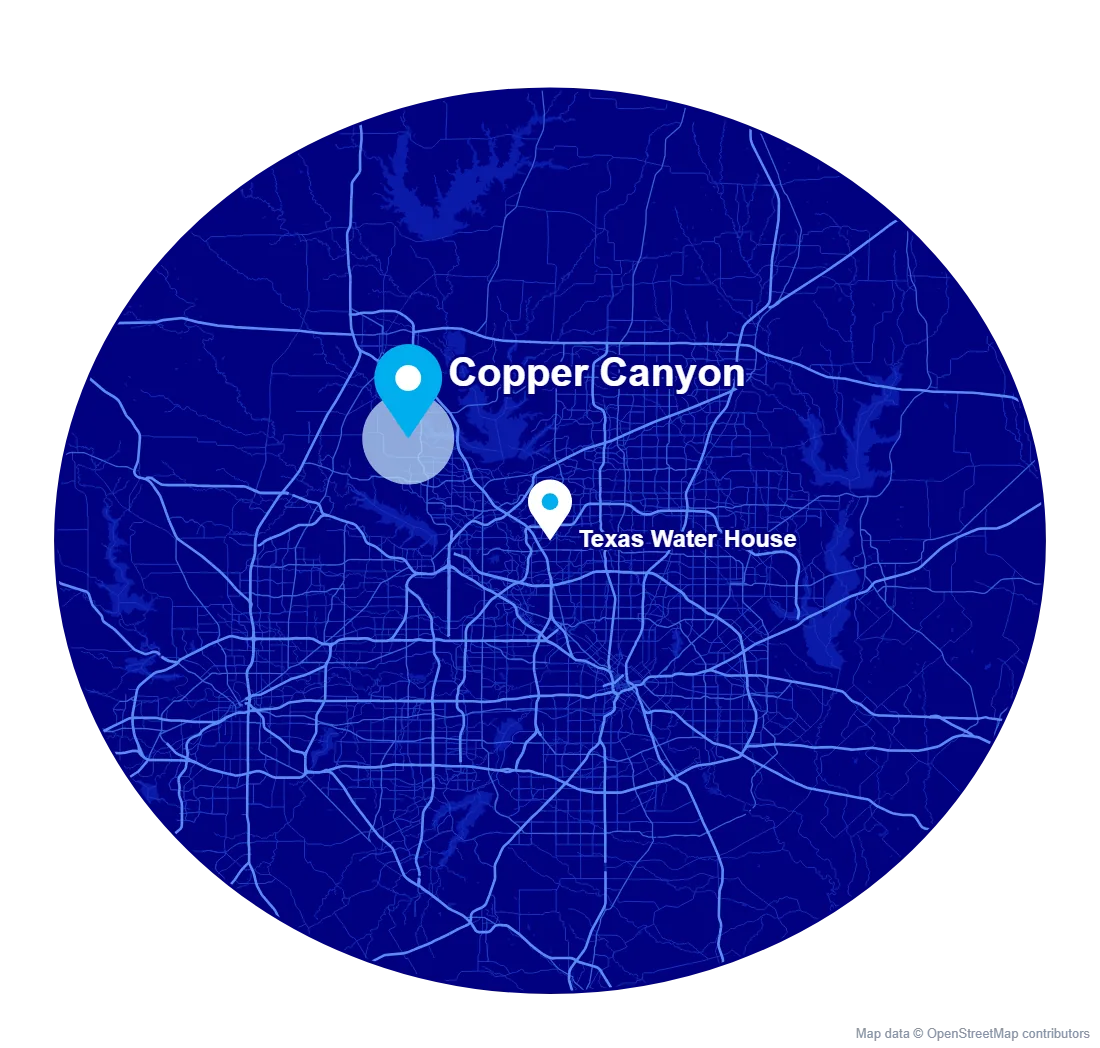
HOW HARD IS COPPER CANYON’S WATER?
Full Copper Canyon water report ↗Whole house water filtration in Copper Canyon ↗Bottled water delivery in Copper Canyon ↗Copper Canyon.
No hardness figure on file for Copper Canyon yet.
Copper Canyon is a Cross Timbers Water Supply Corporation town, and the corporation's Copper Hill Circle site holds both a well and the Upper Trinity lake-water connection; its report prints no hardness figure.
COMMON SIGNS OF HARD WATER
What each grain per gallon looks like at home.
With no figure for Copper Canyon, the signs are the measure. Three or more of these, and the free water test will put a number on it.
Cloudy glassware and white spots the dishwasher cannot rinse off: the minerals that dry out of every gallon.
The white crust is limescale. It narrows spray holes and seizes aerators and valves.
Calcium and magnesium react with soap before it foams: more soap, and scum on tubs and shower doors.
The same soap curd settles on skin and hair and does not rinse away.
Minerals bind to fabric and detergent. Towels come out stiff, whites go grey, colors fade sooner.
Scale coats heating elements and clogs small valves, so appliances work harder and fail sooner.
COPPER CANYON’S WATER, BY HARDNESS
Well and lake water through one site on Copper Hill Circle, and no hardness figure
In Copper Canyon the two halves of Cross Timbers Water Supply Corporation's supply arrive at the same gate. The corporation's 2025 report lists the Copper Hill well at 1180 Copper Hill Circle and, at the same address, the active surface water delivery from Upper Trinity Regional Water District. The federal facility record fills in the site: a Copper Hill pump station with 2.0 and 0.3 million gallon ground tanks and three 3,500 gallon-a-minute pumps, beside a 500 gallon-a-minute well plant. The corporation's history page places the Copper Hill pump station rebuild and the Chinn Chapel and Jernigan well upgrades in the Copper Canyon area, with the Jernigan well at 410 Jernigan Road running through its own 600 gallon-a-minute plant. Two emergency interconnects back the system up, with Argyle Water Supply Corporation on Gibbons Road and with the Lantana district on FM 407, both listed as surface water. The Jernigan station on Jernigan Road carries two 108,000 gallon ground tanks of its own.
The report names the aquifers, Trinity Sands and Paluxy, and the lakes, Lewisville and Chapman, and then prints no hardness for either water. Its results are chloramine averaging 1.68 ppm, fluoride at 0.248 to 0.499 ppm, barium at 0.046 to 0.06 ppm, nitrate at 0.709 ppm, lead, copper and radium. Fluoride is the one line that hints at two waters: Upper Trinity adds none and reported 0.26 ppm in 2025, so the higher readings in the corporation's range are above anything the lake plant delivered. For hardness there is only context. The state water board describes the Trinity Group as fresh, very hard water at the outcrop that grows saltier with depth, and the Woodbine that overlies it as carrying under 1,000 milligrams per liter of dissolved solids down to 1,500 feet; depth decides whether a well gives hard water or the soft, sodium-rich kind the Mustang district's deep wells produce at under 6 ppm. The lake side is the moderately hard to hard reservoir water that Dallas measures at 120 to 155 mg/L in its own system, drawn from the same river. Neither number is Copper Canyon's. The corporation's consumer information page describes the testing behind those tables: bacteriological samples are collected every month, the state runs a chemical analysis every three years, and the pumps and stations are monitored remotely for flow, pressure and emergencies.
Where you live in town matters less than the corporation's valves on the day. Water leaving Copper Hill Circle may be well water, Upper Trinity water or the two in one tank, and the corporation's figures for the summer of 2021, 2.8 million gallons a day from wells against 2.5 million purchased, show how close to even the split can run at peak. The hardness at a Copper Canyon tap therefore has no published value, and the honest answer is a measured one: a free water test at your sink reports the total hardness you actually have, in grains, and a softener sized to the higher reading, the lake-water end, will not come up short when the mix changes. The history page also gives the system's margins, a conservative emergency yield of 6.2 million gallons a day with the wells rated for 18 hours of safe running a day, and the corporation's home page currently posts Stage 2 Yellow restrictions, with outdoor watering by address and none on Sundays.
Sources: Cross Timbers WSC 2025 Consumer Confidence Report · U.S. EPA Envirofacts SDWIS: water system facilities for TX0610020 · Cross Timbers Water Supply Corporation: History · Texas Water Development Board: Trinity Aquifer · Texas Water Development Board: Woodbine Aquifer · Mustang SUD 2025 Annual Drinking Water Quality Report · Upper Trinity Regional Water District 2025 Consumer Confidence Report · City of Dallas memorandum, December 1, 2023: Community Water Fluoridation Follow Up · Cross Timbers Water Supply Corporation: Consumer Information · Cross Timbers Water Supply Corporation: home page
HOW A SOFTENER WORKS
Ion exchange, salt and regeneration.
One tank of resin, one tank of salt, and a valve that runs the cycle.
Resin beads hold sodium ions. Calcium and magnesium swap onto the beads as water passes, and the water leaves at close to zero grains.
When the beads fill up, brine from the salt tank rinses the hardness to the drain and reloads the sodium, metered by the gallons you use.
Calcium, magnesium and a little dissolved iron. Not chlorine, chloramine, PFAS, lead or taste: that is a filter’s job, so see whole house water filtration for Copper Canyon, and a reverse osmosis tap or bottled water delivery for drinking water.
A salt-free water conditioner turns hardness into crystals that stay in the water instead of on heaters and pipes: no salt, no drain, less scale, no relief for soap and skin.
HARDNESS QUESTIONS, ANSWERED
The hard water FAQ for Copper Canyon.
Is Copper Canyon’s water hard?
There is no figure to quote. Cross Timbers WSC's 2025 report prints no hardness for its Trinity and Paluxy wells or for the lake water Upper Trinity delivers to Copper Hill Circle in Copper Canyon. Whether the well water is hard depends on the well; the lake water is hard. The free water test at your tap settles it.
Is hard water safe to drink?
Yes. Hardness is calcium and magnesium, minerals with no federal drinking-water limit. It is a plumbing, appliance, soap and skin problem, not a health one.
Does a softener make my water salty?
No. The salt goes down the drain at regeneration; the water carries a little sodium in proportion to the hardness removed, which a reverse osmosis tap removes again.
THE SOURCE MATTERS
Where the number comes from.
Each figure is read from the document linked beside it, in its own units and period. A missing result stays missing; a range stays a range.
Hardness result
None on file for Copper Canyon.
Utility of record: Cross Timbers Water Supply Corporation · PWS TX0610020
Checked: EWG Tap Water Database entry ↗ (2013-2024), Cross Timbers Water Supply Corporation water quality report ↗ (2025). They hold 9 results for Copper Canyon: Haloacetic acids (HAA5) 2.64 ppb; Perfluorohexane sulfonate (PFHXS) 0.55 ppt; Total trihalomethanes (TTHMs) 10.3 ppb; Perfluorobutane sulfonate (PFBS) 0.444 ppt; Perfluorobutanoic Acid (PFBA) 0.563 ppt; Perfluorohexanoic Acid (PFHxA) 0.794 ppt; Perfluoropentanoic Acid (PFPeA) 0.781 ppt; Chloramines 1.68 ppm; Lead — 90th percentile 1.15 ppb. None is a hardness result.
Hardness scale
USGS Water Science School: hardness of water ↗
USGS hardness scale, mg/L as CaCO3: soft 0 to 60; moderately hard 61 to 120; hard 121 to 180; very hard over 180.
FREE WATER TEST IN COPPER CANYON
Start with a
free water test.
We measure the hardness at your tap, size the softener in grains to that number, and install it ourselves.