
Whole House Water Softeners in Melissa
For over 55 years, Texas Water House has been North Texas’s trusted partner for premium whole house water softener systems. Our custom-designed water softening solutions protect your home’s plumbing, extend appliance life, and deliver silky-soft water to every tap in your home. Whether you’re concerned about hard water, dry skin, or the long-term health of your plumbing system, our whole house water softeners provide comprehensive protection.
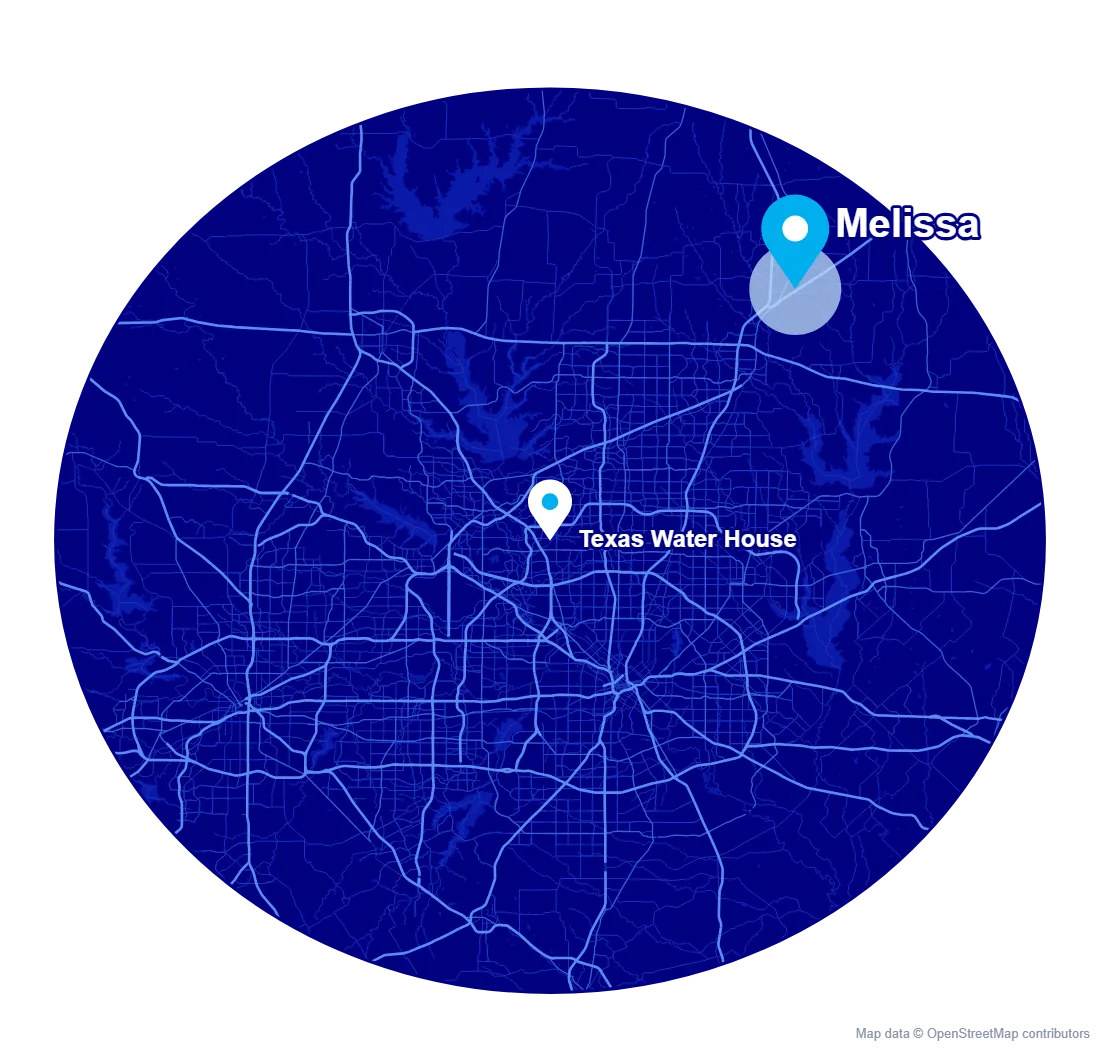
Northern Texas
service area
At Texas Water House, we are committed to delivering outstanding water solutions to a wide array of locations across Northern Texas. Our services are designed to meet the unique needs of each community, ensuring access to clean, safe, and high-quality water for both residential and commercial clients. Trust Texas Water House to be your partner in ensuring the highest standards of water quality and service excellence in the greater DFW area.
HOW HARD IS MELISSA’S WATER?
Full Melissa water report ↗Whole house water filtration in Melissa ↗Bottled water delivery in Melissa ↗Melissa.
200 ppm. That is 11.7 grains per gallon.
The Melissa water quality report lists a total hardness of 200 ppm as its highest result, with a reported range of 96 to 200 ppm (5.6 to 11.7 grains per gallon). On the USGS hardness scale that is moderately hard to very hard water.
COMMON SIGNS OF HARD WATER
What 11.7 grains per gallon looks like at home.
At about 11.7 grains per gallon, every one of these shows up in Melissa sooner or later. The water test tells you how soon.
Cloudy glassware and white spots the dishwasher cannot rinse off: about 11.7 grains of dried mineral per gallon.
The white crust is limescale. It narrows spray holes and seizes aerators and valves.
Calcium and magnesium react with soap before it foams: more soap, and scum on tubs and shower doors.
The same soap curd settles on skin and hair and does not rinse away.
Minerals bind to fabric and detergent. Towels come out stiff, whites go grey, colors fade sooner.
Scale coats heating elements and clogs small valves, so appliances work harder and fail sooner.
MELISSA’S WATER, BY HARDNESS
Two district plants in one report, 96 to 200 mg/L from Wylie
Melissa's 2025 water quality report prints two complete sets of district data, one headed NTMWD Wylie Water Treatment Plants and one headed NTMWD Leonard Water Treatment Plants, because the city can receive water from either. The Leonard side begins at Bois d'Arc Lake, which the Texas Water Development Board records on Bois d'Arc Creek in Fannin County at 16,526 acres and 367,609 acre-feet at its conservation pool, with impoundment from April 14, 2021 and diversions to the treatment plant from March 2023. The report also explains the taste of late summer: each July and August, lakes can experience natural algae blooms, and blue-green algae release compounds with a grassy or earthy character that the district's laboratory watches for and treats with extra steps, without changing the quality of the finished water. On minerals the report is plain. Calcium, sodium and iron are what the state, not the EPA, regulates as secondary constituents, and they affect appearance and taste rather than health. The report lists the city's well as a source but prints no separate results for its water. Melissa's own part of the system is the network. The report counts 161 miles of distribution lines, 8,998 active residential connections and 1,625 fire hydrants, names the North Elevated Storage Tower and a leak detection and repair program among recent investments, and puts the 2025 water loss at 53.19 gallons per connection per day. The federal SDWIS facility list for system TX0430040 adds a 2.0 million gallon elevated tank on Throckmorton Road, a Central Street pump station with 0.75 million gallons elevated, 0.5 million on the ground and three 1,350 gallon-per-minute pumps, a Surrey Circle station with a 0.25 million gallon ground tank, two 700 gallon-per-minute pumps and the well, and records 26,234 people served.
The figure on this page, 200 mg/L, is the highest 2025 result from the Wylie plants, whose range ran 96.0 to 200: moderately hard where the year bottoms out and very hard where it peaks, roughly 5.6 grains per gallon rising to 11.7. The Leonard column is gentler, 96.0 to 144 mg/L, hard rather than very hard at its peak, about 8.4 grains. The two columns differ in exactly the minerals a softener removes. The Wylie rows show calcium of 31.2 to 61.3 ppm with magnesium of 6.27 to 9.44 ppm; the Leonard rows show calcium of 39.7 to 52.4 ppm and a flat 2.69 ppm of magnesium. Dissolved solids tell the same story, 182 to 455 ppm from Wylie against 194 to 253 from Leonard, and sodium was 41.9 to 88.0 ppm from Wylie against 21.7 to 34.6 from Leonard. Both are reservoir waters, and both plants deliver what the district calls moderately hard water, a description it ties to the minerals in Lavon Lake for its Wylie supply, to be converted to grains by dividing mg/L by 17.12.
Which column applies at a Melissa tap depends on which delivery is feeding that part of the system on that day, and the report does not map the two connections to streets. The safe reading for a homeowner is the Wylie range, because it contains the Leonard range entirely and sets the ceiling at 200. In practice a Melissa kitchen can see anything from about 5.6 to 11.7 grains across a year, and the gap between a spring month and an August month can be wider than the gap between the two plants. Size a softener to the top of the Wylie range, about 12 grains per gallon, let a metered valve regenerate less often when the water runs lighter, and use the free water test to learn which water, and how much hardness, your own tap carried on the day.
Sources: City of Melissa, 2025 Consumer Confidence Report · Texas Water Development Board, Bois d'Arc Lake · North Texas Municipal Water District, Water Quality · EPA SDWIS water system record record for TX0430040, City of Melissa: population served, system type · EPA SDWIS water system facility records records for TX0430040
HOW A SOFTENER WORKS
Ion exchange, salt and regeneration.
One tank of resin, one tank of salt, and a valve that runs the cycle.
Resin beads hold sodium ions. Calcium and magnesium swap onto the beads as water passes, and the water leaves at close to zero grains.
When the beads fill up, brine from the salt tank rinses the hardness to the drain and reloads the sodium, metered by the gallons you use.
Calcium, magnesium and a little dissolved iron. Not chlorine, chloramine, PFAS, lead or taste: that is a filter’s job, so see whole house water filtration for Melissa, and a reverse osmosis tap or bottled water delivery for drinking water.
A salt-free water conditioner turns hardness into crystals that stay in the water instead of on heaters and pipes: no salt, no drain, less scale, no relief for soap and skin.
HARDNESS QUESTIONS, ANSWERED
The hard water FAQ for Melissa.
Is Melissa’s water hard?
Yes. Melissa's 2025 report prints total hardness of 200 mg/L at its highest from the district's Wylie plants, on a range of 96.0 to 200, moderately hard to very hard, about 5.6 to 11.7 grains per gallon. Water from the Leonard plant, which Melissa can also receive, ran 96.0 to 144 mg/L. The free water test tells you which your tap carried.
Is hard water safe to drink?
Yes. Hardness is calcium and magnesium, minerals with no federal drinking-water limit. It is a plumbing, appliance, soap and skin problem, not a health one.
Does a softener make my water salty?
No. The salt goes down the drain at regeneration; the water carries a little sodium in proportion to the hardness removed, which a reverse osmosis tap removes again.
THE SOURCE MATTERS
Where the number comes from.
Each figure is read from the document linked beside it, in its own units and period. A missing result stays missing; a range stays a range.
Hardness result
Melissa water quality report ↗
2025
City of Melissa · PWS TX0430040
Highest reported result; published range 96–200 mg/L as CaCO3
Hardness scale
USGS Water Science School: hardness of water ↗
USGS hardness scale, mg/L as CaCO3: soft 0 to 60; moderately hard 61 to 120; hard 121 to 180; very hard over 180.
FREE WATER TEST IN MELISSA
Start with a
free water test.
We measure the hardness at your tap, size the softener in grains to that number, and install it ourselves.