
Whole House Water Softeners in Van Alstyne
For over 55 years, Texas Water House has been North Texas’s trusted partner for premium whole house water softener systems. Our custom-designed water softening solutions protect your home’s plumbing, extend appliance life, and deliver silky-soft water to every tap in your home. Whether you’re concerned about hard water, dry skin, or the long-term health of your plumbing system, our whole house water softeners provide comprehensive protection.
Northern Texas
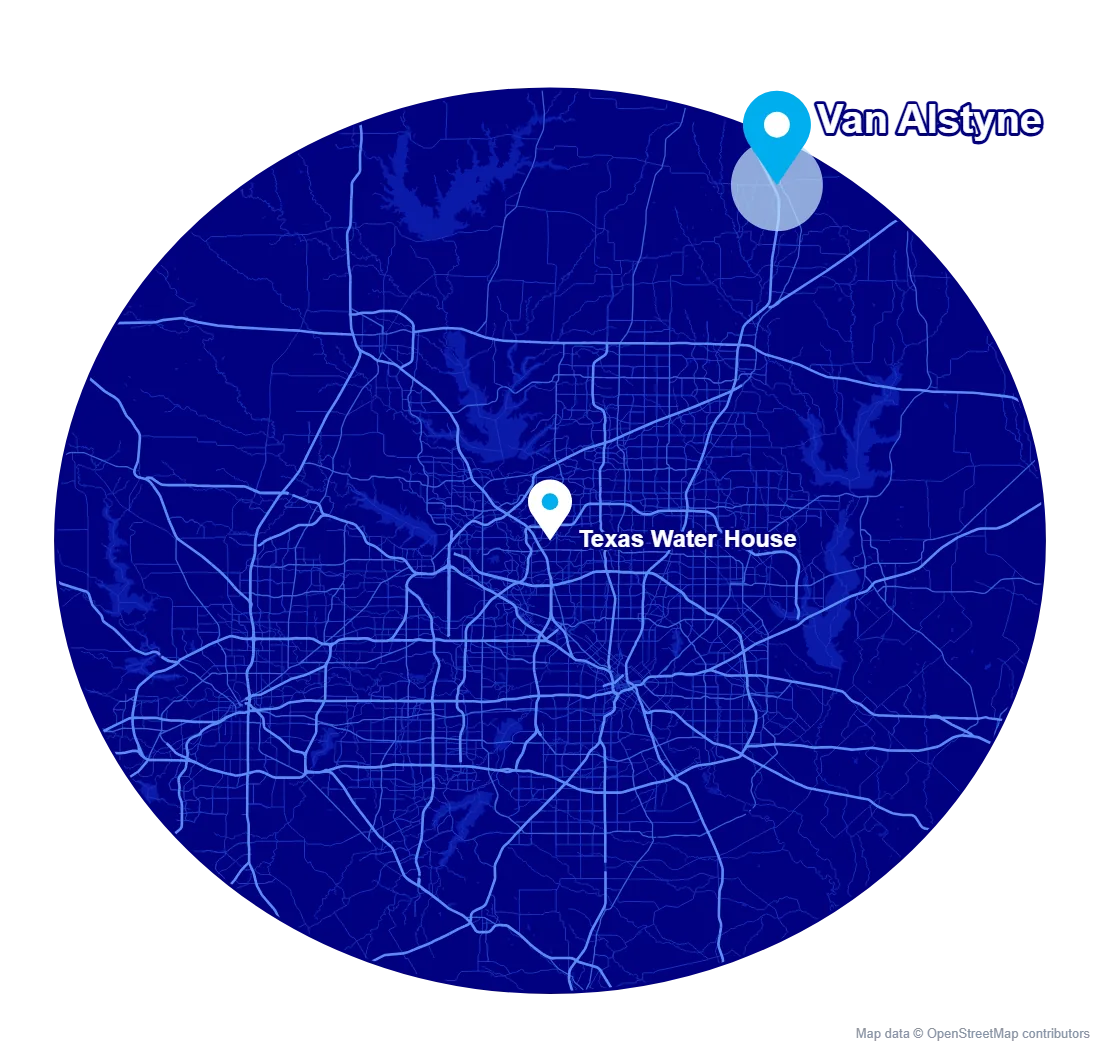
service area
At Texas Water House, we are committed to delivering outstanding water solutions to a wide array of locations across Northern Texas. Our services are designed to meet the unique needs of each community, ensuring access to clean, safe, and high-quality water for both residential and commercial clients. Trust Texas Water House to be your partner in ensuring the highest standards of water quality and service excellence in the greater DFW area.
HOW HARD IS VAN ALSTYNE’S WATER?
Full Van Alstyne water report ↗Whole house water filtration in Van Alstyne ↗Bottled water delivery in Van Alstyne ↗Van Alstyne.
144 ppm. That is 8.4 grains per gallon.
The City of Van Alstyne 2025 water quality report lists a total hardness of 144 ppm as its highest result, with a reported range of 96 to 144 ppm (5.6 to 8.4 grains per gallon). On the USGS hardness scale that is moderately hard to hard water. The 144 ppm figure is the hardness of the Leonard plant water Van Alstyne buys; the city's own report prints no figure for the wells that supply most of its water.
COMMON SIGNS OF HARD WATER
What 8.4 grains per gallon looks like at home.
At about 8.4 grains per gallon, every one of these shows up in Van Alstyne sooner or later. The water test tells you how soon.
Cloudy glassware and white spots the dishwasher cannot rinse off: about 8.4 grains of dried mineral per gallon.
The white crust is limescale. It narrows spray holes and seizes aerators and valves.
Calcium and magnesium react with soap before it foams: more soap, and scum on tubs and shower doors.
The same soap curd settles on skin and hair and does not rinse away.
Minerals bind to fabric and detergent. Towels come out stiff, whites go grey, colors fade sooner.
Scale coats heating elements and clogs small valves, so appliances work harder and fail sooner.
VAN ALSTYNE’S WATER, BY HARDNESS
Mostly very soft well water, with Leonard plant lake water at 96 to 144 ppm
The hardness table in Van Alstyne's 2025 water quality report sits on page 11 under the heading of the North Texas Municipal Water District, and it describes one thing only: the surface water the city buys. The report says that water comes from the district's Leonard plant, east of the city, and that city staff test it daily at the interconnection where it arrives, alongside daily testing at the city's own plant. Behind Leonard is Bois d'Arc Lake, a Fannin County reservoir on Bois d'Arc Creek that the state water board lists at 16,526 acres holding 367,609 acre-feet, filling since April 14, 2021 and supplying the plant since March 2023. The city's wells are a different world. They reach 1500 to 2500 feet into the Woodbine and the deeper Trinity, and the report rates their water's quality highly. Most of what runs in Van Alstyne's mains is that well water; the lake water tops it up, and the two meet in the same pipes.
The page's figure, 144 ppm, is the top of the Leonard range of 96.0 to 144 ppm for 2025: moderately hard to hard, about 5.6 to 8.4 grains per gallon. That is lower than the 96.0 to 200 ppm the district's Wylie plant printed for the same year in Allen's and Melissa's reports, and the reason shows in the table. Leonard water carried calcium at 39.7 to 52.4 ppm but only 2.69 ppm of magnesium, with total alkalinity of 83.6 to 133 ppm, dissolved solids of 194 to 253 ppm and sodium of 21.7 to 34.6 ppm, at a pH of 7.9 to 8.7. The wells have no row in that table at all. What the report says about them is in words: the groundwater is naturally very soft, so soft that some residents notice a slick or slippery feel, which the report explains as a natural characteristic of soft water. The Texas Water Development Board's aquifer notes point the same way: Woodbine water is fresh, under 1,000 mg/L of dissolved solids, to about 1,500 feet down, and Trinity water is very hard where the sands reach the surface but gains dissolved solids with depth, and deep sandstone water of that kind has typically exchanged its calcium and magnesium for sodium.
Because the city blends the two, the report itself tells residents that some areas may notice softer water at certain times and that the purchased water, with its higher mineral content, is considered harder, so the feel can differ from one neighborhood to another and from one month to the next. No single number describes a Van Alstyne tap. The figure here is a ceiling for the purchased water: a softener sized for about 8.4 grains per gallon covers the Leonard water at its hardest, and on well-fed days it will scarcely regenerate. The free water test measures the blend at your own faucet, and that measured figure, not the district's, is the one to size to.
Sources: City of Van Alstyne, 2025 Water Quality Report · Texas Water Development Board, Bois d'Arc Lake · Texas Water Development Board, Woodbine Aquifer · Texas Water Development Board, Trinity Aquifer · City of Allen, 2026 Water Quality Report · City of Melissa, 2025 Consumer Confidence Report
HOW A SOFTENER WORKS
Ion exchange, salt and regeneration.
One tank of resin, one tank of salt, and a valve that runs the cycle.
Resin beads hold sodium ions. Calcium and magnesium swap onto the beads as water passes, and the water leaves at close to zero grains.
When the beads fill up, brine from the salt tank rinses the hardness to the drain and reloads the sodium, metered by the gallons you use.
Calcium, magnesium and a little dissolved iron. Not chlorine, chloramine, PFAS, lead or taste: that is a filter’s job, so see whole house water filtration for Van Alstyne, and a reverse osmosis tap or bottled water delivery for drinking water.
A salt-free water conditioner turns hardness into crystals that stay in the water instead of on heaters and pipes: no salt, no drain, less scale, no relief for soap and skin.
HARDNESS QUESTIONS, ANSWERED
The hard water FAQ for Van Alstyne.
Is Van Alstyne’s water hard?
Partly. The 144 ppm figure, on a range of 96.0 to 144 ppm, is the district's Leonard plant water that makes up the smaller share of Van Alstyne's supply: moderately hard to hard, about 5.6 to 8.4 grains per gallon. The city's own report describes its deep well water, the larger share, as naturally very soft, with no figure printed. The free water test gives the blend at your tap.
Is hard water safe to drink?
Yes. Hardness is calcium and magnesium, minerals with no federal drinking-water limit. It is a plumbing, appliance, soap and skin problem, not a health one.
Does a softener make my water salty?
No. The salt goes down the drain at regeneration; the water carries a little sodium in proportion to the hardness removed, which a reverse osmosis tap removes again.
THE SOURCE MATTERS
Where the number comes from.
Each figure is read from the document linked beside it, in its own units and period. A missing result stays missing; a range stays a range.
Hardness result
City of Van Alstyne 2025 water quality report ↗
2025
City of Van Alstyne · PWS TX0910009
Highest level detected; reported range 96.0–144 ppm
Hardness scale
USGS Water Science School: hardness of water ↗
USGS hardness scale, mg/L as CaCO3: soft 0 to 60; moderately hard 61 to 120; hard 121 to 180; very hard over 180.
FREE WATER TEST IN VAN ALSTYNE
Start with a
free water test.
We measure the hardness at your tap, size the softener in grains to that number, and install it ourselves.